
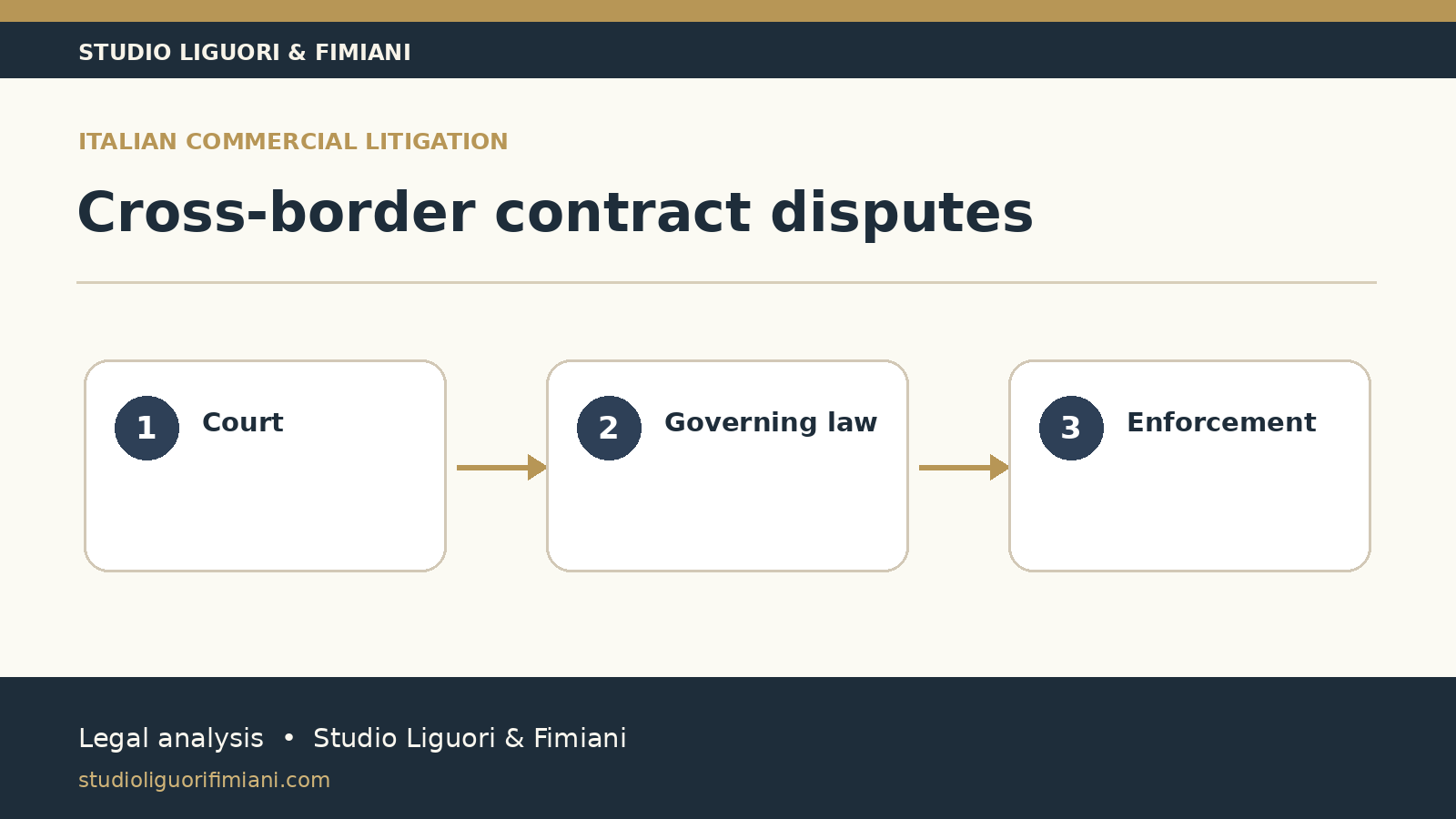
A supplier signs a contract stating that Italian law governs the agreement. After a dispute, it assumes proceedings must also be brought in Italy. The assumption can be costly. Governing law and jurisdiction answer different questions: one identifies substantive rules used to decide the claim, the other identifies the court empowered to hear it. Their interaction matters before litigation, when disputes can still be priced and documentary weaknesses corrected.
Rome I and Brussels I-bis have different functions
Within their fields of application, Regulation (EC) 593/2008 (Rome I) determines the law applicable to contractual obligations, while Regulation (EU) 1215/2012 (Brussels I-bis) governs jurisdiction and the recognition and enforcement of judgments in civil and commercial matters. Choosing Italian law does not, by itself, produce an exclusive Italian forum.
Likewise, an agreement selecting a court in one Member State does not automatically make that state’s law govern the contract. Commercial templates often place both clauses in the same section, which makes the distinction easy to overlook. A sound review reads each provision separately and then assesses how they operate together.
The actual agreement, not merely the last PDF
Article 25 of Brussels I-bis addresses agreements conferring jurisdiction under specified conditions. The threshold question may be whether the parties actually agreed to the clause in a legally effective form. Purchase orders, conditions incorporated by reference, digital acceptance steps and conflicting sets of standard terms can create a dispute before the merits are reached.
A prominent forum clause in unsigned general terms is not automatically decisive. The chronology of offers, acknowledgments and performance should be reconstructed to identify which terms were accepted. For a multi-year trading relationship, successive versions may govern different orders.
Default jurisdiction and performance
If there is no effective exclusive jurisdiction agreement, the regulation’s ordinary and special jurisdiction rules require attention to the defendant, the contractual claim and the relevant place of performance. Delivery and service arrangements may matter; so can the precise nature of the alleged obligation.
Incoterms and transport documents can be relevant evidence, but a shipping instruction should not be treated as a universal answer to the jurisdiction analysis. There may also be related claims or multiple parties, and separate jurisdictional protections apply in certain fields outside ordinary B2B relationships.
Enforcement belongs in the initial risk assessment
A judgment is valuable only if it can be enforced against the correct legal entity and assets. Before suing an Italian company, verify the registered entity, its financial position, any security and the prospects of effective collection. A foreign court may have jurisdiction while meaningful assets are located in Italy, or vice versa.
Cross-border recognition rules may facilitate enforcement, but they do not make an insolvent debtor solvent. Choice-of-court clauses should therefore be negotiated alongside payment security, evidence preservation, dispute escalation and the location of assets, rather than left to the final page of the contract.
Contract review checklist
The value of careful drafting is often invisible while the contract performs. It becomes apparent when a dispute arises and the parties discover whether they can resolve it in one legally coherent forum.
- Identify the governing-law clause and test its scope.
- Review the forum clause separately, including exclusivity and evidence of acceptance.
- Check where obligations are performed and what rules apply absent an agreed forum.
- Map the contracting entities, guarantors and assets against possible enforcement routes.
- Ensure the dispute provisions work for the actual size and risk of the business relationship.
Primary legal sources
Regulation (EC) 593/2008, Rome I
Regulation (EU) 1215/2012, Brussels I-bis
Assessment of a specific matter
A meaningful assessment requires the underlying documents, parties and relevant facts.
Cross-border commercial disputes and contractual advice · legal@studioliguorifimiani.eu
General information only, not advice on an individual case. Contact does not establish an engagement or suspend deadlines.