
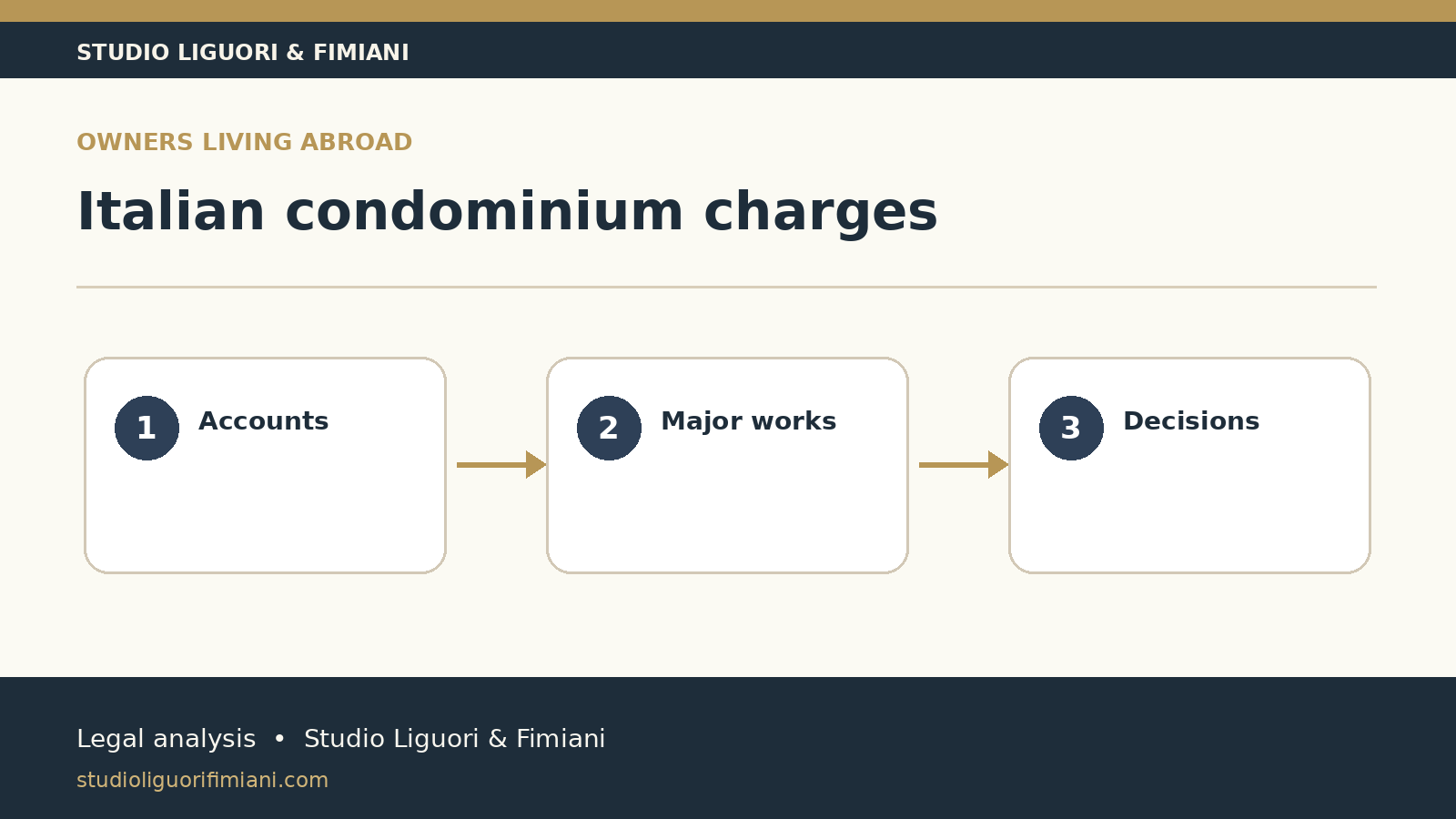
An overseas buyer of an Italian apartment may receive a request for condominium charges relating to the period before completion, or find that the owners’ meeting approved expensive façade works. Italian condominio rules cannot be reduced to the practice of a UK management company, a US homeowners’ association or another foreign system. The exact accounts, ownership dates and assembly resolutions matter.
Identify the common property and the allocation of costs
Italian condominium law distinguishes individually owned units from common parts, which may include roofs, stairs, façades and essential installations. The legal title, condominium rules and millesimi allocation tables help establish how costs are divided. Not every expense is necessarily allocated by the same criterion, particularly when a facility serves only some units.
Obtain the regulations, accounts, budgets, current statements, minutes of meetings and records of planned works. Compare these documents with the seller’s representations and the sale contract.
Can the buyer be asked for charges left unpaid by the seller?
Under Article 63 of the implementing provisions of the Italian Civil Code, the person succeeding to the rights of a condominium owner is jointly liable with the transferor, within the provision’s scope, for condominium contributions relating to the current and previous accounting year. The precise accounting period, contributions and legal relationship must be checked. An agreement under which the seller promises to bear those sums does not necessarily bind the condominium.
A pre-completion statement from the administrator is therefore valuable, especially where arrears, disputed allocations or significant approved expenditure exist. The legal review separates claims by the condominium from contractual claims between buyer and seller.
Major works: a quotation is not an assembly resolution
Façade refurbishment, roof repairs, lift replacement and seismic works may involve significant costs. Ask whether a legally relevant assembly decision has been adopted, when, and what exactly it authorised. The timing of resolutions and transfer of ownership can matter for the respective obligations of buyer and seller. Payment demands, budget amendments and contract arrangements must be read together.
Article 1135 of the Civil Code addresses important powers of the condominium assembly; other provisions govern calling meetings, voting, validity and challenging resolutions. The required majority and available challenges depend on the particular decision.
Practical issues for an owner who lives abroad
- Agree reliable arrangements for receiving assembly notices, accounts and important correspondence.
- Examine whether a proxy can be used and what form the particular meeting requires.
- Retain dated notices and meeting minutes, especially where a resolution may need to be challenged.
- Check whether planned repairs require access to the unit or involve private and common areas.
- Ask early about the deadline for a challenge rather than assuming negotiations stop time running.
Water penetration and common parts
Damage originating from a roof, terrace or shared pipeline calls for technical investigation and review of property titles and condominium rules. Potential responsibility may rest with the condominium, an individual owner or a contractor, depending on the evidence. Insurance coverage and urgent mitigation should be coordinated without prejudging fault.
Three questions often asked by foreign owners
Can I contest an assembly resolution from overseas?
Italian law provides routes to challenge qualifying decisions, subject to requirements and deadlines. Relevant records and the owner’s position must be examined first.
Can the buyer and seller agree who pays for old charges?
They can allocate costs between themselves, but that arrangement does not automatically defeat statutory rights of the condominium.
Does a foreign property manager replace an Italian administrator?
No. The legal duties and powers of the Italian amministratore follow the applicable Italian regime.
Italian-law assistance for apartment owners
The firm can examine arrears, resolutions, contracts and dispute documents relating to property in Italy. See Italian property and condominium disputes or send a concise enquiry to the legal team at legal@studioliguorifimiani.eu.
Official and institutional sources: Italian Civil Code (Articles 1117, 1123, 1135 and 1137); Law 220/2012, Gazzetta Ufficiale (reform of Article 63 implementing provisions); National Council of Notaries, condominium guide.
General legal information. The accounts, resolutions and applicable time limits of the particular building require individual review.