
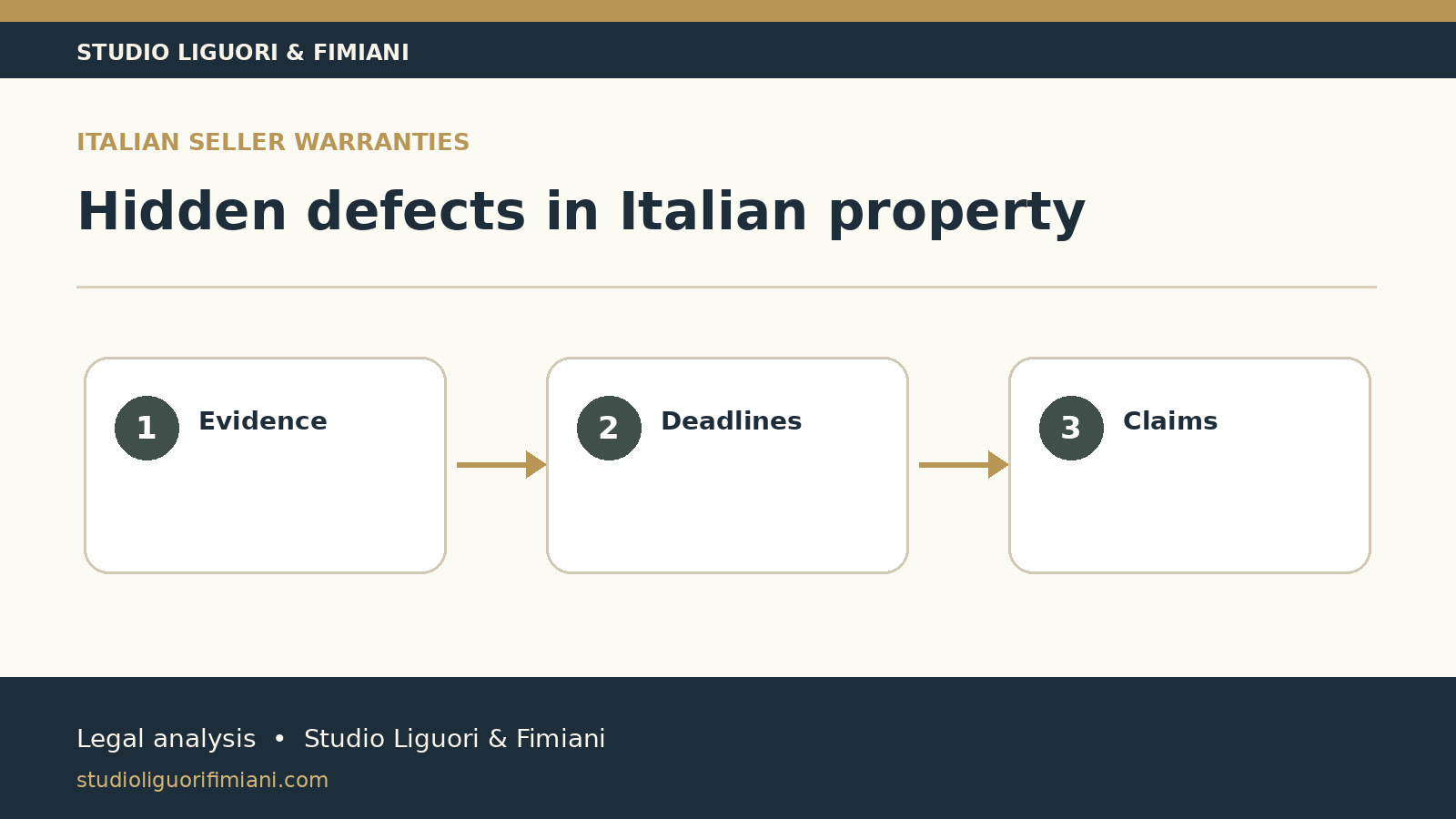
A buyer living abroad completes on an Italian home and later discovers recurring water infiltration, structural cracking or defective renovations. The fact that a problem emerges after completion does not establish that it is legally a hidden defect or that the seller must pay for all repairs. The relevant contract, severity of the defect, available evidence and statutory deadlines are decisive.
What the Italian seller’s warranty covers
Article 1490 of the Italian Civil Code provides, subject to its conditions, a seller’s warranty for defects making the property unfit for its intended use or materially diminishing its value. Ordinary wear, a defect already apparent or expressly known to the buyer, and a serious undisclosed problem may require different treatment. The legal inquiry must consider what the seller said, what could reasonably be inspected and what the parties agreed.
Where the warranty applies, Article 1492 provides, in the relevant circumstances, for rescission of the sale or reduction of the purchase price. Any claim for loss must be separately assessed. A clause excluding warranty does not necessarily protect a seller who concealed a defect in bad faith.
Short notification and limitation periods make timing critical
Under Article 1495, the ordinary rule includes notice of defects within eight days of discovery, unless the law or parties provide a different period and subject to the statutory exceptions; the action is generally subject to a one-year period from delivery. These periods cannot be applied mechanically to every construction dispute, consumer transaction or alternative legal classification. An early legal review is important precisely because several regimes may appear relevant.
Record when the problem first became identifiable, the communications with the seller and any previous repairs. Informal negotiations should never be assumed to suspend a deadline. If urgent safety work is necessary, seek technical advice promptly while preserving as much evidence as practicable.
When the contractor or builder may be responsible
A new build or major renovation may also raise obligations under the construction contract. In certain circumstances, Article 1669 deals with collapse, danger of collapse and serious defects in long-lasting buildings, subject to its own conditions and deadlines. It is not a general warranty for every cosmetic imperfection. Identifying the original contractor, completion date, handover and subsequent work is essential.
The seller, contractor, designer, surveyor, condominium and insurer may each occupy legally distinct positions. An independent building report should describe likely causes and necessary measures; the legal analysis then identifies the relevant obligations and defendants.
Build a credible evidence file before the property changes
- Keep the purchase deed, advertisement, seller questionnaire, pre-contract messages and any surveys.
- Date photographs and videos showing the progression of moisture, cracking or failures.
- Obtain a qualified technical opinion on cause, scope, urgency and possible remedial cost.
- Preserve invoices, insurance correspondence, contractor records and condominium minutes.
- Before extensive non-emergency repairs, consider the need for a formal inspection or a process in which the opposing party can participate.
Defects in shared parts of an apartment building
A leaking roof or terrace may involve the Italian condominio, a particular owner or a contractor. The building’s legal title, regulations and technical evidence determine which parts are common and which obligations may be engaged. A claim directed exclusively at the seller may miss the central issue.
Questions that change the legal assessment
Can I wait until I return to Italy to report a problem?
That may be dangerous if a short statutory or contractual deadline applies. The dates and available notification methods need urgent review.
Does ‘sold as seen’ end all remedies?
Not necessarily. The wording must be read against the governing legal regime, the nature of the alleged defect and any dishonest concealment.
Will a private engineer’s report decide the case?
It can be important evidence, but it is not automatically a court-appointed expert report. Its scope and procedural usefulness depend on the circumstances.
Legal assessment of an Italian property defect
For an Italian property dispute, the firm can review title documents, notices and technical reports and assess potential legal steps. Further information: property disputes in Italy and English enquiries. Legal matters: legal@studioliguorifimiani.eu.
Official source: Italian Civil Code (Articles 1490, 1492, 1495 and 1669).
General information, not a legal opinion on a particular property. Immediate advice may be necessary where deadlines or safety risks arise.