
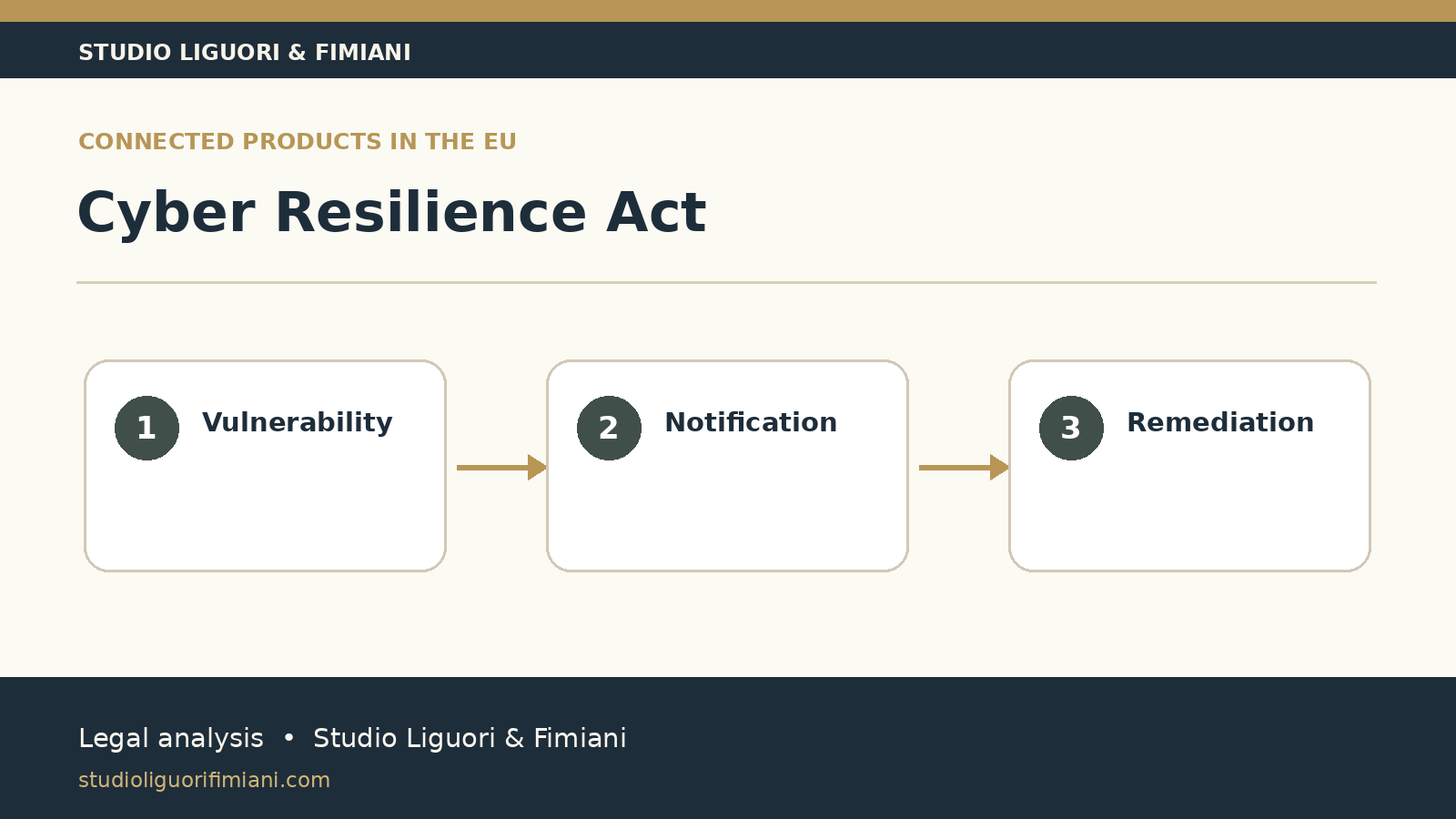
A manufacturer discovers that a vulnerability in an internet-connected controller is being actively exploited. Its Italian distributor asks for immediate reassurance; the software supplier is still investigating. At that point, commercial communications and the regulatory reporting duty must be managed on different tracks. Since 11 September 2026, selected reporting obligations under the EU Cyber Resilience Act already apply, although the regulation’s principal product requirements have a later application date.
Two application dates, two types of work
Regulation (EU) 2024/2847 establishes horizontal cybersecurity requirements for products with digital elements. Its core obligations generally apply from 11 December 2027. The reporting provisions concerning actively exploited vulnerabilities and severe incidents affecting product security apply from 11 September 2026. Treating the framework as wholly deferred until 2027 would therefore miss a duty already in force.
The fact that the full compliance regime is still approaching does not mean every software malfunction is reportable. The legal classification turns on the regulatory definitions, the impact on product security and the circumstances of exploitation or incident. A technical severity label used internally may not answer the legal question.
When a vulnerability enters the reporting analysis
The first task is to establish what happened: whether the weakness is present in a product with digital elements, whether evidence indicates active exploitation, which versions are affected and what the impact is. Manufacturers need reliable information from development teams, external researchers, component vendors and downstream business partners.
The regulation lays down structured notification obligations and timeframes; the reporting path should be checked against the current operational arrangements established under the legal framework. A company should avoid copying an incident statement from a different cybersecurity law without verifying that the definitions and addressees coincide.
Supply contracts matter before an incident
A distributor may be the first to learn of a vulnerability while the manufacturer holds the technical evidence. A hosting provider may control logs, and a component vendor may control the patch. None of those contractual arrangements should be assumed to transfer statutory duties automatically. They should instead specify rapid information-sharing, designated contacts, confidentiality, cooperation during investigation and traceability of remedial steps.
This is also a product-liability and business-continuity issue. Delayed or contradictory statements may affect a manufacturer’s ability to identify affected batches, communicate with customers and document the adequacy of its response. Regulatory compliance and contractual recourse should be assessed separately, with a shared factual timeline.
Incident dossier: facts before conclusions
Preserve the discovery time, version inventory, evidence of exploitation, affected product configurations, containment decisions, notification records and subsequent corrective actions. Record who made each decision, on what information and with which uncertainties. A contemporaneous record is more reliable than a narrative assembled only after a regulator or customer asks questions.
Where an Italian importer or distributor is involved, the company should clarify which entity is the manufacturer and how the product reaches the EU market. The business relationship may include legal obligations under several product and cybersecurity instruments, with different triggers and dates.
A practical readiness test
Cyber resilience is not measured solely by a written policy. The first real test is whether the organisation can assemble dependable facts quickly enough to meet a legal reporting obligation while containing the technical risk.
- Identify products with digital elements and their software/component ownership.
- Map the internal path from vulnerability discovery to legal classification and notification.
- Ensure contracts require rapid reporting by vendors and distributors, without claiming to shift statutory duties.
- Test how evidence, patches and customer communications will be preserved.
- Review the later 2027 product-security requirements as a separate implementation workstream.
Primary legal sources
Regulation (EU) 2024/2847 (Cyber Resilience Act)
European Commission, 11 September 2026, application of CRA reporting duties
Assessment of a specific matter
A meaningful assessment requires the underlying documents, parties and relevant facts.
Legal assistance for international suppliers operating in Italy · legal@studioliguorifimiani.eu
General information only, not advice on an individual case. Contact does not establish an engagement or suspend deadlines.