
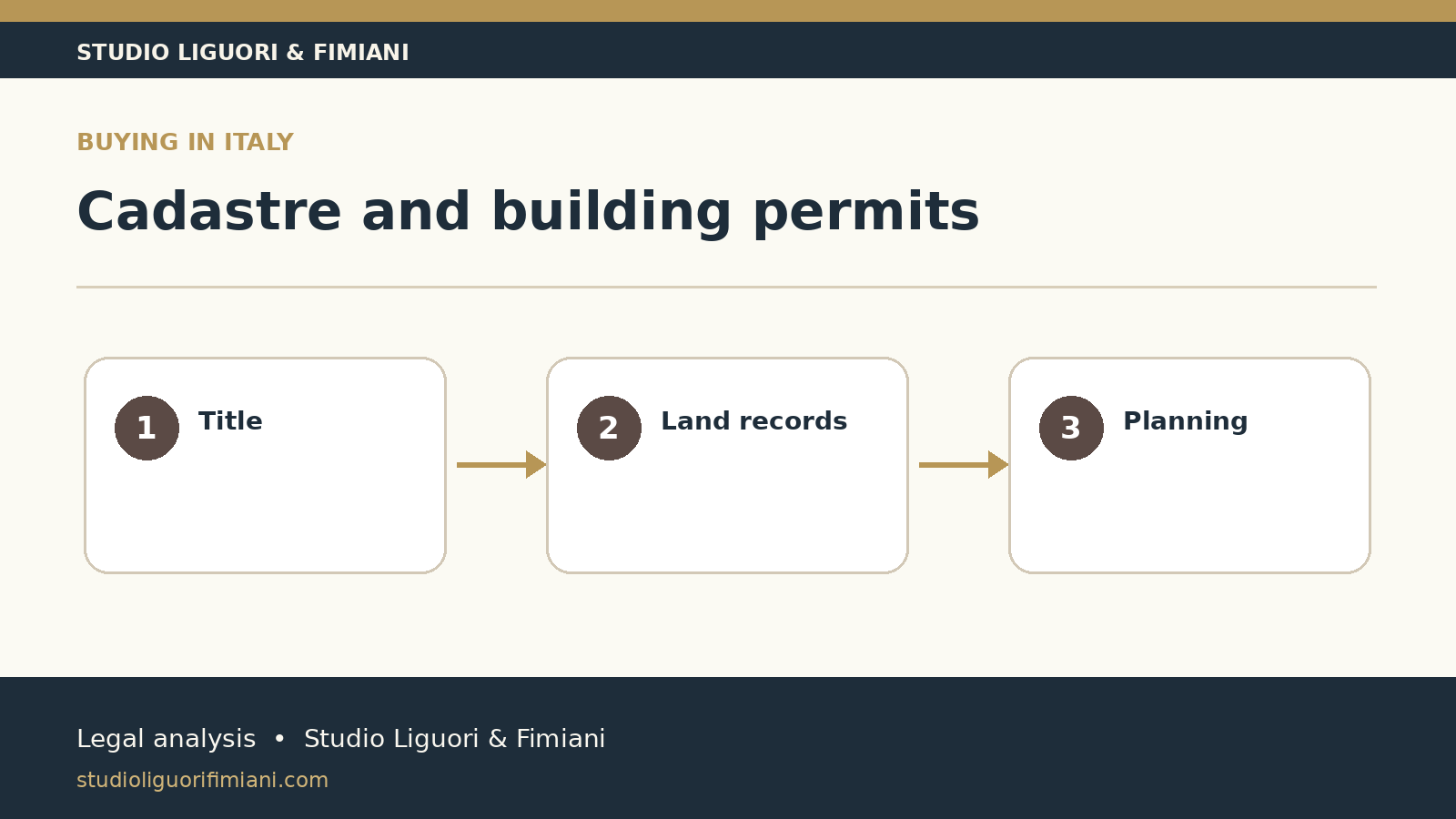
The plans supplied for an Italian holiday home show an extra bedroom, enclosed terrace or converted rural annex. The estate agent says that everything is ‘on the cadastre’. Does that prove the works were authorised? No. Property title, real-estate publicity, cadastral identification and building-law compliance are related but legally different matters.
Four sets of records answer different questions
- Title deeds: the legal basis on which the seller acquired the property and the rights intended to be transferred.
- Real-estate registers: relevant transcriptions, mortgage registrations and other public-record entries concerning rights and encumbrances.
- Cadastre: identification, descriptive and graphical data concerning units and land; cadastral consistency alone is not proof of planning lawfulness.
- Building and planning records: administrative titles, authorisations, declared works and the legally relevant history of construction or conversion.
A careful transaction review compares these records against the actual condition of the building. The cadastral map should never be treated as a substitute for an expert review of planning and building files.
Italian building law and the property’s lawful status
Presidential Decree No. 380/2001 (D.P.R. 380/2001) is a central source for Italian building law. The appropriate assessment of the stato legittimo depends on the applicable legislation, historic construction and works, local plans and the documentary record. Subsequent reforms and regional provisions can be relevant. Neither the age of an alteration nor the presence of a cadastral entry is a universal guarantee that a problem can be regularised.
An enclosed balcony, enlarged ground floor, converted barn or altered internal layout may raise different issues. A suitably qualified surveyor, architect or engineer can assess the actual state, inspect local records and identify any authorisation or regularisation question.
What to check before paying a deposit
Before signing a binding proposta d’acquisto or preliminare, ask for the ownership deed, relevant real-estate searches, cadastral material, municipal construction documents, information on extensions, servitudes and restrictions, and condominium records where applicable. The documents should be obtained sufficiently early to inform the conditions of purchase, not only just before the notarial deed.
The notary’s statutory duties, the technical verification and the lawyer’s review of contractual rights and risk allocation are complementary. A legal report should identify the documents actually checked, the issues reserved to technical advisers and matters that require further evidence.
The promise to ‘legalise the extension later’
A seller may offer to obtain a missing permit after completion. The feasibility, costs and timing of any corrective process are legal and technical questions requiring evidence. An open-ended promise should not be treated as equivalent to an authorisation already obtained. Appropriate contract drafting may need to address responsibility for documents, deadlines, conditions to completion and consequences if the expected outcome is not lawfully available.
Older buildings, tourist use and rural properties
Historic houses, rural outbuildings and apartments intended for short-term letting can introduce further constraints: permitted use, heritage or landscape protection, access rights and locally applicable requirements. Marketing descriptions such as ‘suitable for holiday rentals’ or ‘ready for renovation’ are not legal assurances that the proposed project is permissible.
Questions before a purchase decision
Does a cadastral match prove a property is legal to occupy?
No. Cadastral data and building/planning legality are separate questions.
Will the notarial deed automatically cure an unauthorised alteration?
No. Signing a sale deed does not by itself establish that works complied with building law.
Can I coordinate the checks without being in Italy?
Documents and instructions can often be managed remotely, but municipal searches and site inspection may require professionals on the ground.
Coordinating the legal component of due diligence
For property transactions involving Italy, Studio Liguori & Fimiani can review the legal and contractual implications of technical findings. Start with the Italian property-law overview or English enquiry. Legal correspondence: legal@studioliguorifimiani.eu.
Official references: D.P.R. 380/2001 (Italian building law); Agenzia delle Entrate, property-buying guide (cadastral and mortgage-register checks).
This publication does not certify the compliance of any property. A qualified technical inspection and review of the applicable rules are necessary.